If you've never been to one, the phrase "graduation open house" can be confusing — it sounds like a real-estate term, not a party. But in much of the United States, especially the Midwest and the suburbs, a graduation open house is the default way families celebrate a high school or college graduate, and it looks nothing like a house showing. Here's what it actually is, how it works, what to expect whether you're hosting or attending, and why the format has become so popular.
The short answer
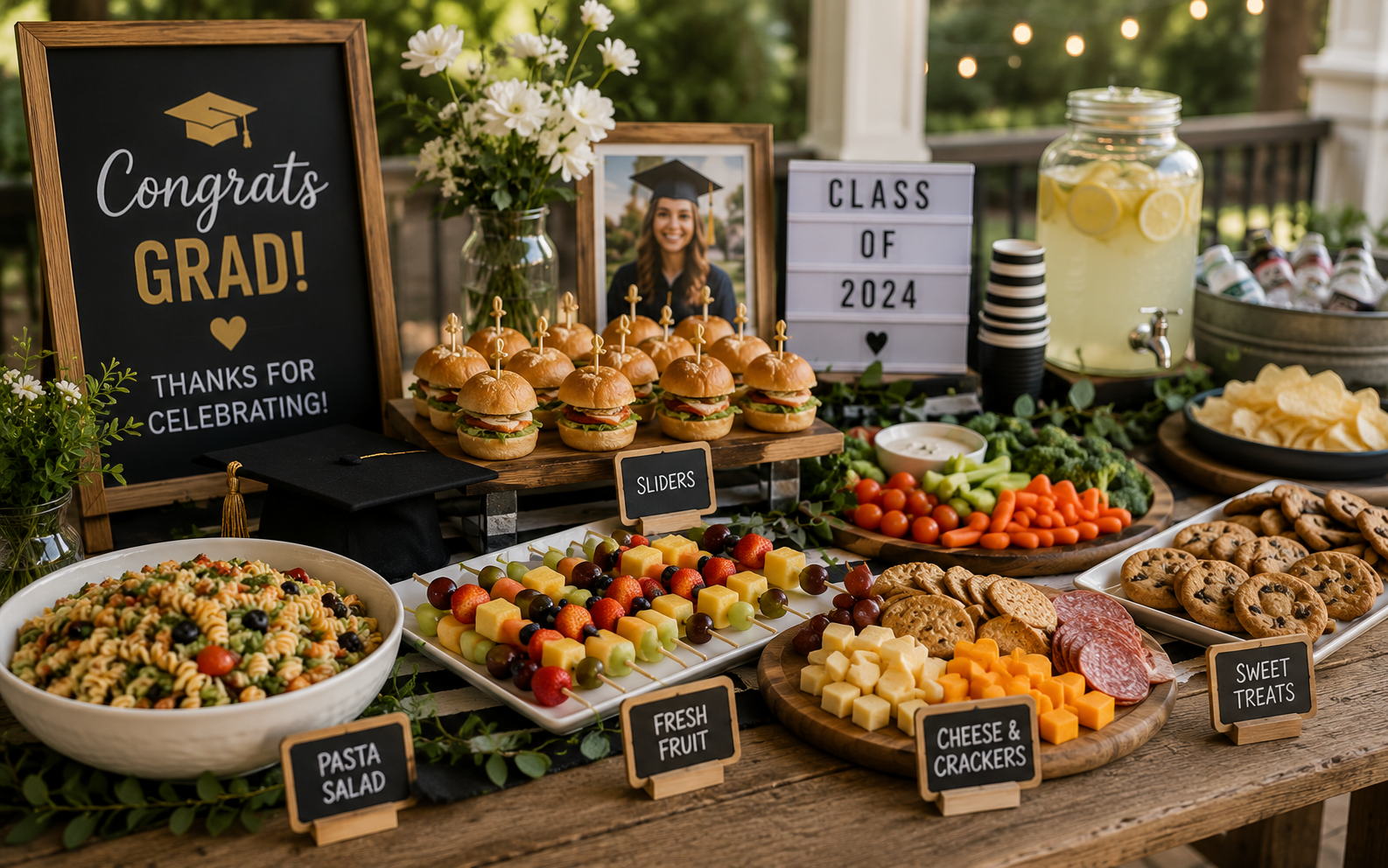
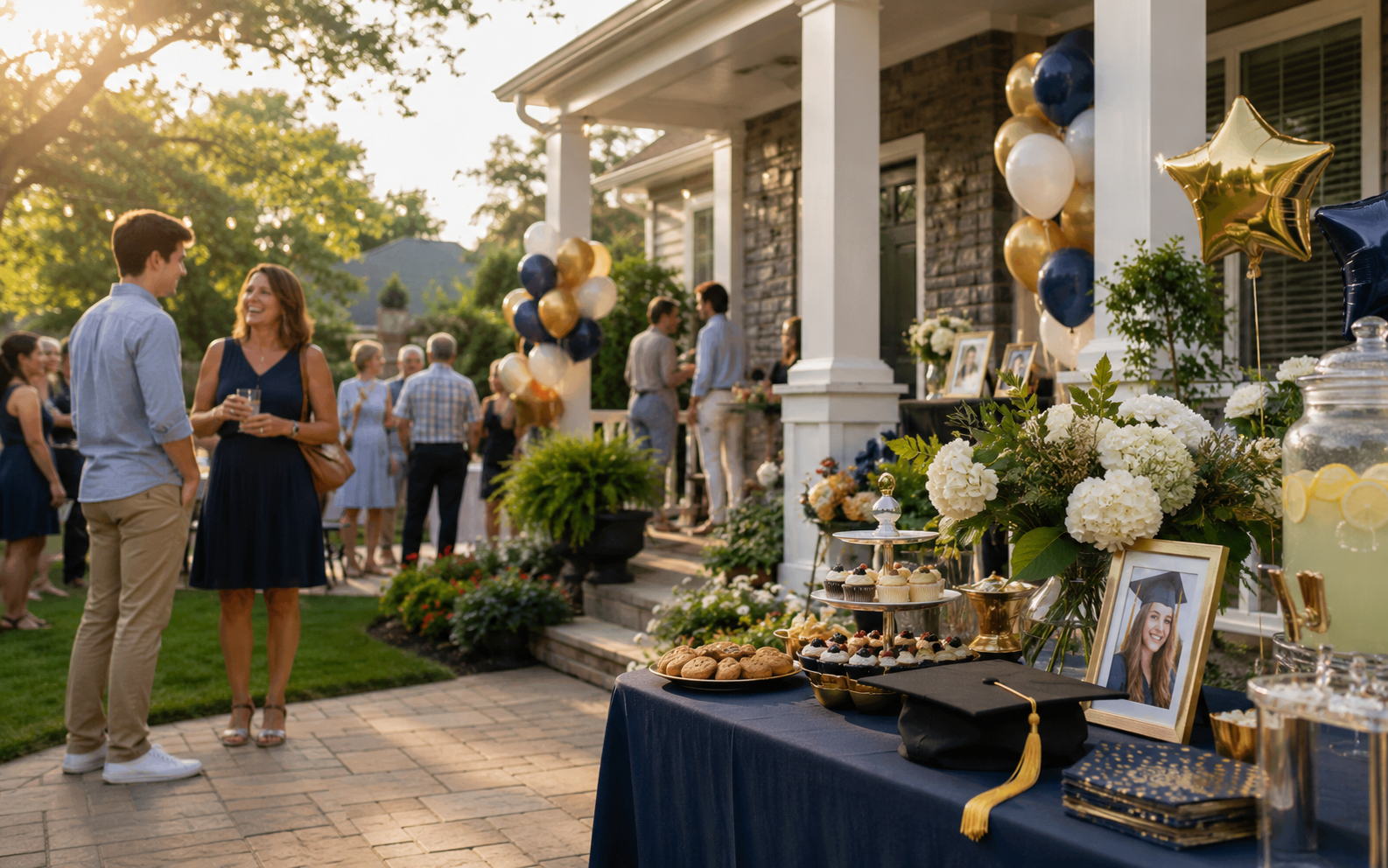
A graduation open house is a come-and-go party over a fixed time window, usually two to four hours. Guests don't all arrive at one start time; instead, they drop in whenever works for them during the window — say, anytime between 1pm and 5pm. Food is casual and self-serve (finger food, not a plated meal), there's no formal program or schedule, and guests mingle at their own pace before heading out. The graduate stands near the food or the main gathering area, greeting people as they cycle through, and the house is never slammed because arrivals are staggered across the whole afternoon.
It has nothing to do with real-estate open houses. Same words, completely different event.
How it differs from a regular graduation party
The distinction matters because it shapes everything — what food to make, how long to host, and what kind of experience guests should expect.
A regular graduation party typically has a single start time, a structured meal (buffet or sit-down), often a program with toasts or speeches, and a defined end. Everyone is present at roughly the same time, which makes group photos and coordinated moments easier but demands more space, more food, and more effort from the host.
A graduation open house replaces all of that with a rolling window. There's no single "everyone's here" moment. Food sits out for hours and refreshes in waves. The party doesn't build toward a climax — it hums at a steady, pleasant level for the whole window. This means the host can invite far more people than the space technically holds, because guests cycle through rather than filling the room all at once. A living room that seats thirty can comfortably serve a hundred-plus invitees across a four-hour window.
Why it's so popular
The open house became the default graduation celebration in much of the country for very practical reasons. Graduation season is a dense thicket of parties — your grad's friends are all celebrating the same weekend — and a fixed-time party forces shared guests to choose one. A come-and-go window lets them hit yours, their neighbor's, and their cousin's all in one afternoon, which means more people actually show up. The format is also forgiving for hosts: there's no single moment where everything has to be perfect and on schedule, just a manageable flow of people eating, chatting, and moving on. And financially, grazing food for a rolling crowd costs significantly less than a seated dinner for a hundred, and a home venue costs nothing at all.
The mixed-generation crowd matters too. Grandparents can arrive early and leave before it gets loud, the graduate's friends can roll in later, and nobody feels trapped at an event that runs longer than they'd like. The casualness makes everyone more comfortable, from the great-aunt who's not sure how long to stay to the neighbor who wasn't sure if they were "really" invited.
What happens at one (for guests who've never been)
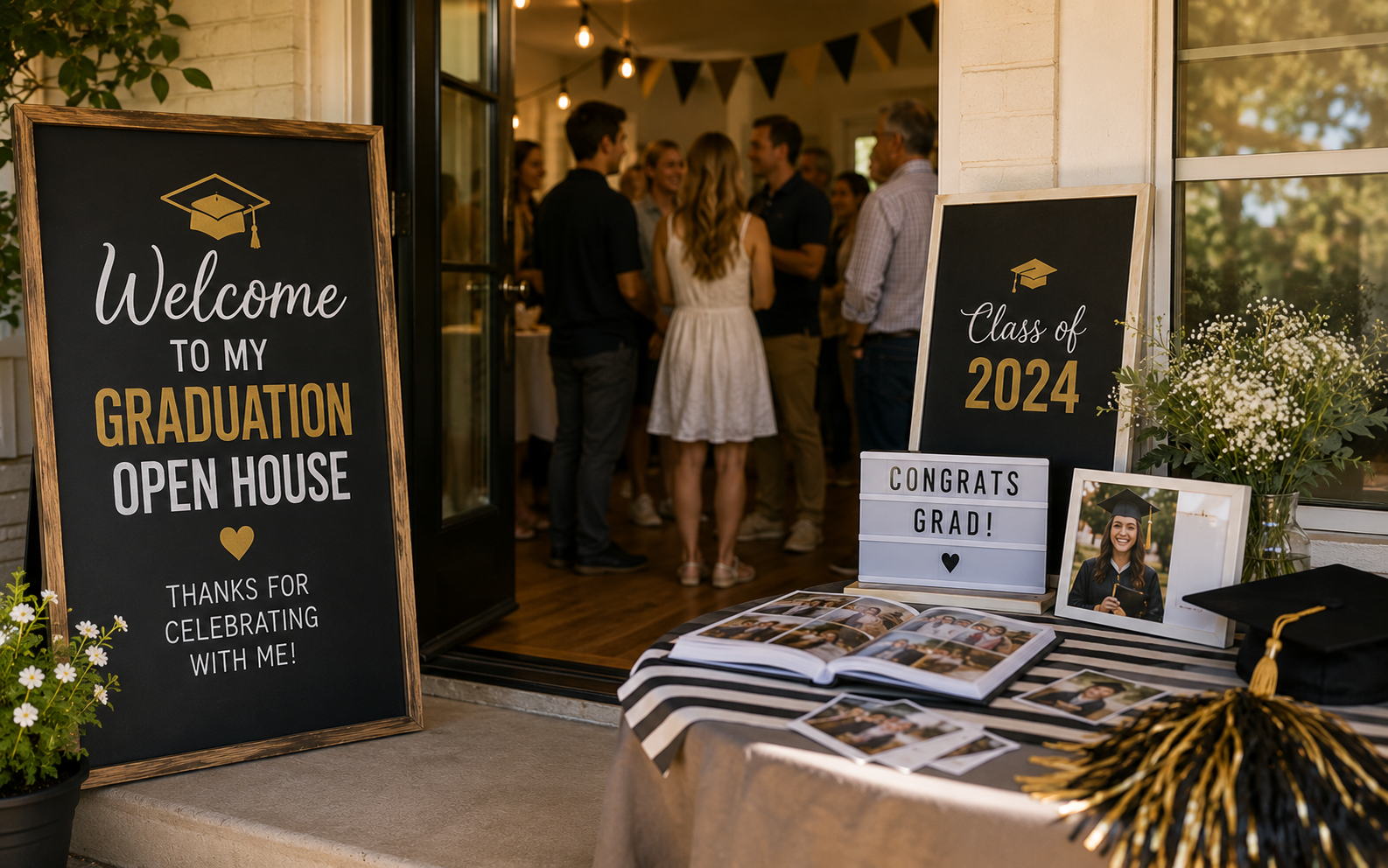
If you're attending a graduation open house for the first time, here's the typical flow from a guest's perspective. You arrive somewhere within the posted window — there's no wrong time, though the middle tends to be busiest. You find the grad, congratulate them, and give them a card or gift. You grab food from the self-serve spread, find somewhere to sit or stand, and mingle. You browse the memory display, maybe sign a guest book or scan a QR code to upload a photo, and chat with whoever's there at the same time. After twenty to forty-five minutes — more if you're close family — you say goodbye and head out. There's no awkward moment of leaving early because leaving is the whole design; the party keeps going with or without you.
Etiquette (for hosts and guests)
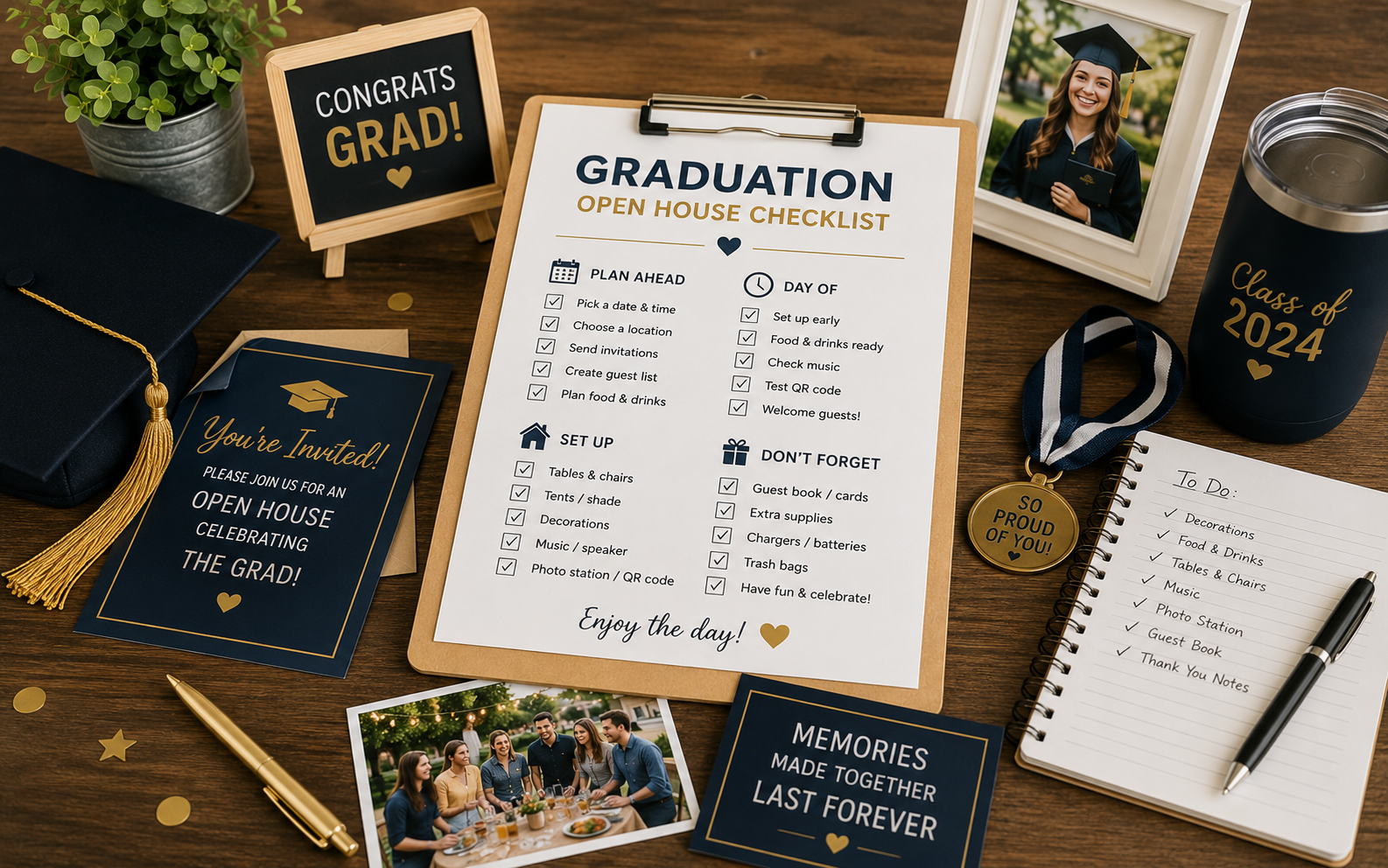
Hosts: put clear hours on the invitation so guests know the window. "Open house, 1–5pm" is all it takes. You don't owe anyone a full meal — grazing food is expected and appropriate. Send thank-you notes within a month, and include a link to the photo gallery if you have one — it doubles as a keepsake and a digital favor.
Guests: plan to stay twenty to forty-five minutes unless you're close family. A card with money is the most common gift, though a small gift is equally fine. Arriving right at the start or near the end is perfectly acceptable — the window means every arrival time is correct. If you know several grads having parties the same day, it's completely normal and polite to visit multiple open houses in one afternoon; hosts expect this and plan for it.
The one weakness of the format
For all its advantages, the open house has a genuine flaw, and it's worth naming plainly: there is never a moment when every guest is present simultaneously. This makes the classic group photo nearly impossible, and it means that any photo strategy built around a single window — a hired photographer for an hour, a rented booth for a two-hour block — will miss most of the day. Different people are there at different times, and the best candids are scattered across dozens of phones that leave the party without sharing.
The fix that fits the format is a QR guest gallery that sits on the tables from the first guest to the last. Everyone who stops by uploads their photos to the same shared album, regardless of when they arrive, and the one o'clock guests and the four o'clock guests both contribute even though they never crossed paths. Grad Moments does exactly this — a photo booth alternative for $49 once, with a digital guest book for audio and video messages, no app, no rental, and no one standing by to run it. It turns the format's biggest weakness into a non-issue.
Is it right for your grad?
The open house is an excellent fit when your guest list is large and varied (family, neighbors, the grad's friends, your friends), when graduation season means competing with other parties on the same weekend, when your budget favors home hosting over a rented venue, and when the graduate's personality is more casual than formal. It's less ideal for very small celebrations where everyone knows each other (a dinner or cocktail format fits better) or for a graduate who specifically wants a structured event with a program. Most high school graduations land squarely in the first camp, which is why the open house dominates.
For the full hosting guide — timeline, food quantities, room layout, and day-of logistics — see the graduation open house pillar, and for a broader comparison of every party format, start with the graduation party ideas hub.
Pillar: Graduation Open House
Frequently Asked Questions
Collecting guest photos?
Grad Moments gives your guests a QR code to upload photos and videos — no app, no login.
See How It Works