If you grew up in the Midwest, you already know the scene: a graduation open house means cars parked along the lawn, casserole dishes from neighbors, and a graduate standing near the door for hours repeating "thanks for coming."
If the format is new to you — or you're planning your first as a parent — here's everything about graduation open house parties: what they are, how they differ from a sit-down party, the timeline, the food, the etiquette, and why collecting photos takes a different strategy than a two-hour banquet.
What is a graduation open house?
An open house graduation party is a come-and-go celebration over a fixed time window, usually 2–4 hours. Guests:
- Arrive whenever is convenient within the window.
- Mingle, graze on finger food, and congratulate the grad.
- Leave without a formal seated meal or program.
It has nothing to do with real-estate open houses — same words, different event. On invitations you'll also see it called a graduate open house or graduation party open house.
The big advantage: because guests don't all show up at once, you can invite far more people than your space technically holds. A living room that seats 30 can host 120 across a four-hour window.
Open house vs sit-down party
| Open house | Sit-down dinner | |
|---|---|---|
| Guest flow | Rolling arrivals | One start time |
| Food | Finger food, grazing | Plated or buffet meal |
| Guest count | Often 50–150+ | Often smaller |
| Photo challenge | Nobody's there all at once | Easier group shots |
| Best fit | Midwest, suburban US, big lists | Anywhere, smaller groups |
Planning timeline
6 weeks out. Send invitations with clear hours: "Open house — drop by anytime 1–5pm, June 14, [address]." Ambiguous timing is the #1 open-house mistake.
2 weeks out. Confirm food quantities for the peak hour, not for every guest eating a full meal simultaneously.
1 week out. Build the day-of flow with the free graduation open house checklist (open-house template).
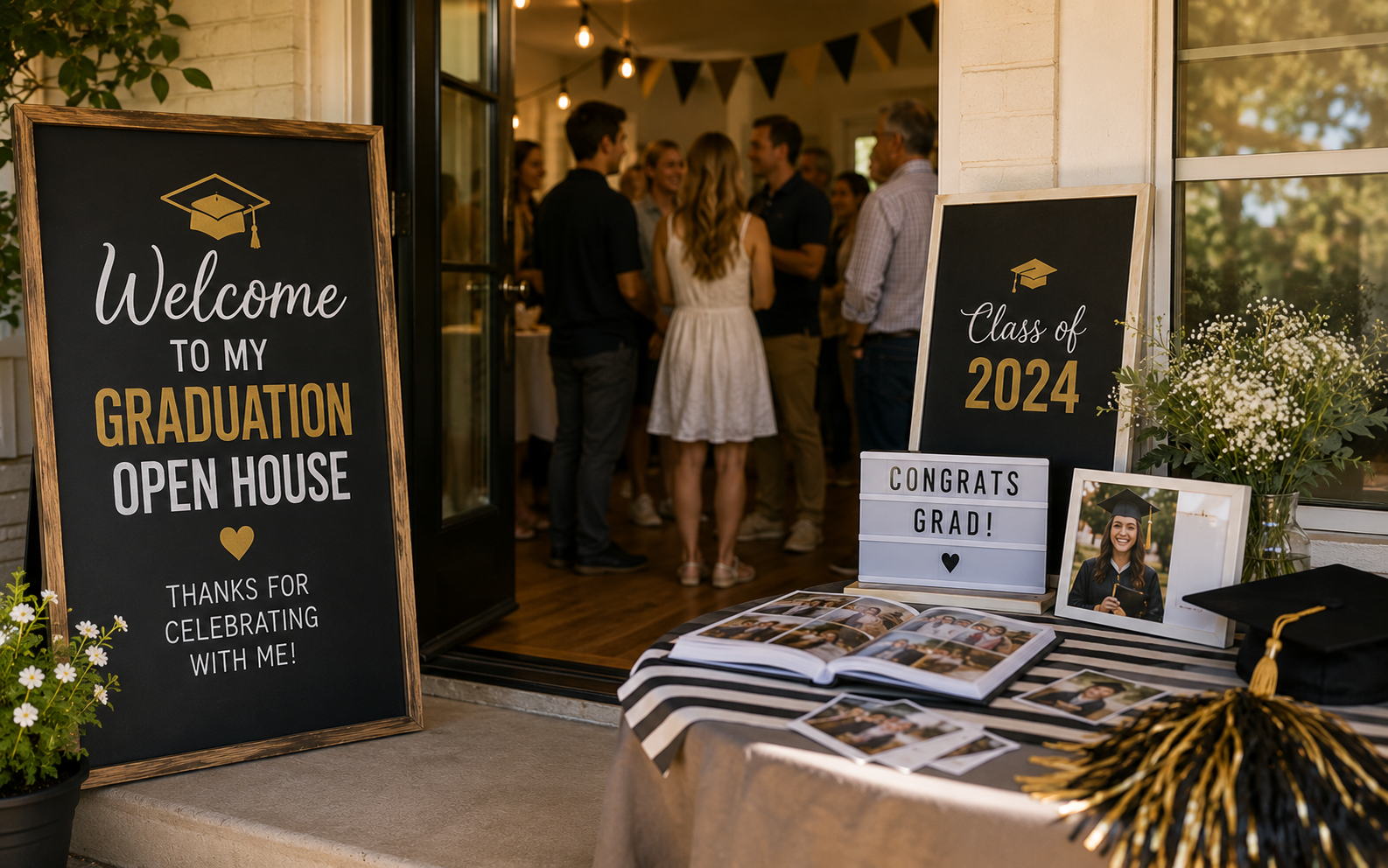
Day of. Set up stations — food, dessert, gifts, guest book, and QR photos — so guests flow naturally through the house or yard.
Full planning walkthrough: how to plan a graduation party.
Food that survives an open house
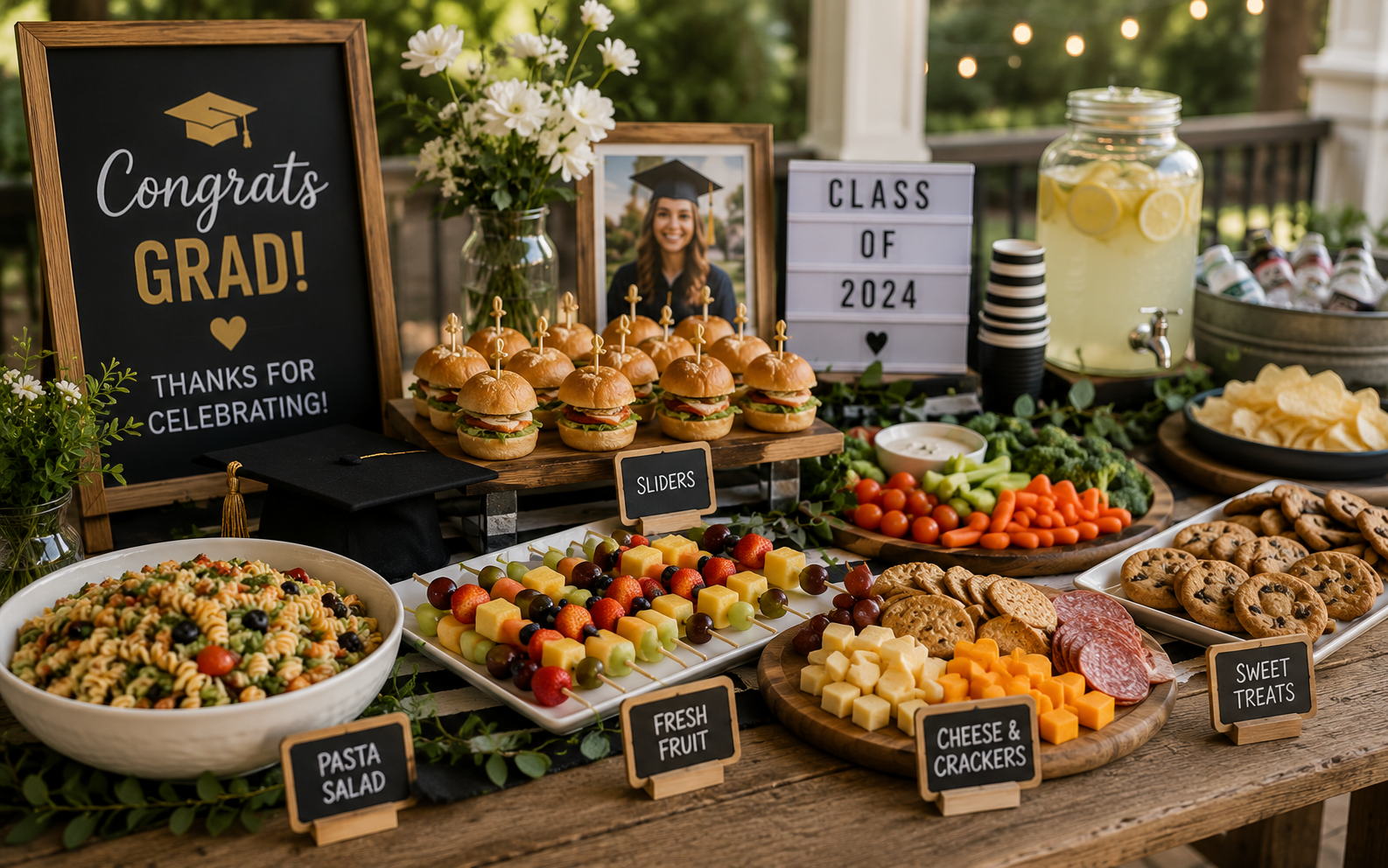
Open-house food has to hold up for hours on a table and feed a rolling crowd. Go grazing, not plated:
- Sliders, mini wraps, and pinwheels.
- Veggie and fruit trays.
- A cheese and cracker board.
- Meatballs or chicken bites kept warm in a slow cooker.
- Cupcakes or cookie bars (far easier than slicing a cake for 100 people).
- A beverage station — water, lemonade, iced tea; adults may bring wine depending on your crowd.
Quantity tip: cater for about 60% of your invite list at once, since they don't all eat at the same time. Avoid anything that wilts in 30 minutes or needs your full attention to serve — you want to enjoy the party, not run a buffet line.
Decorations for an open house
You don't need to decorate the whole house — hit the path guests actually walk:
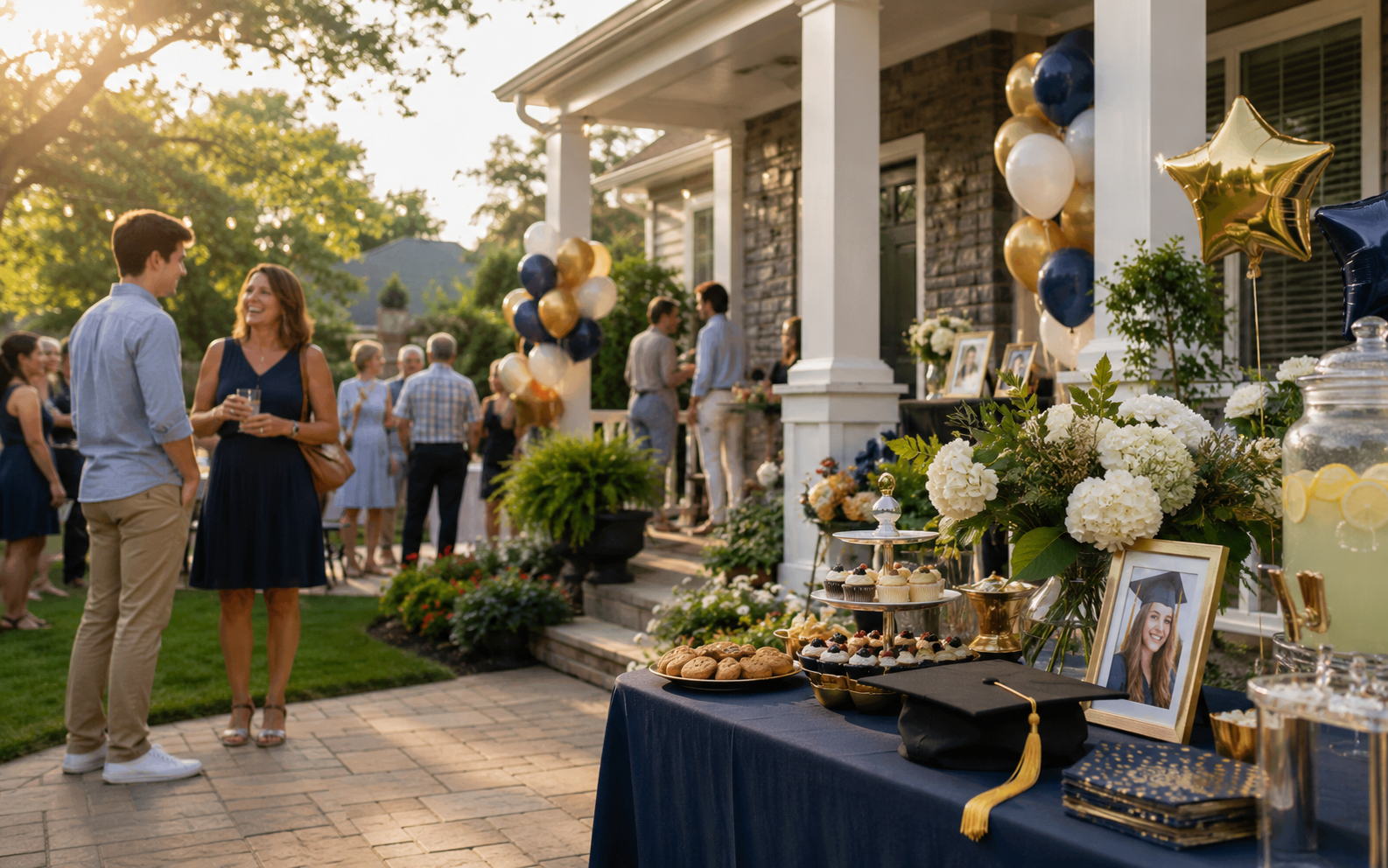
- A welcome sign and balloon accent at the entrance.
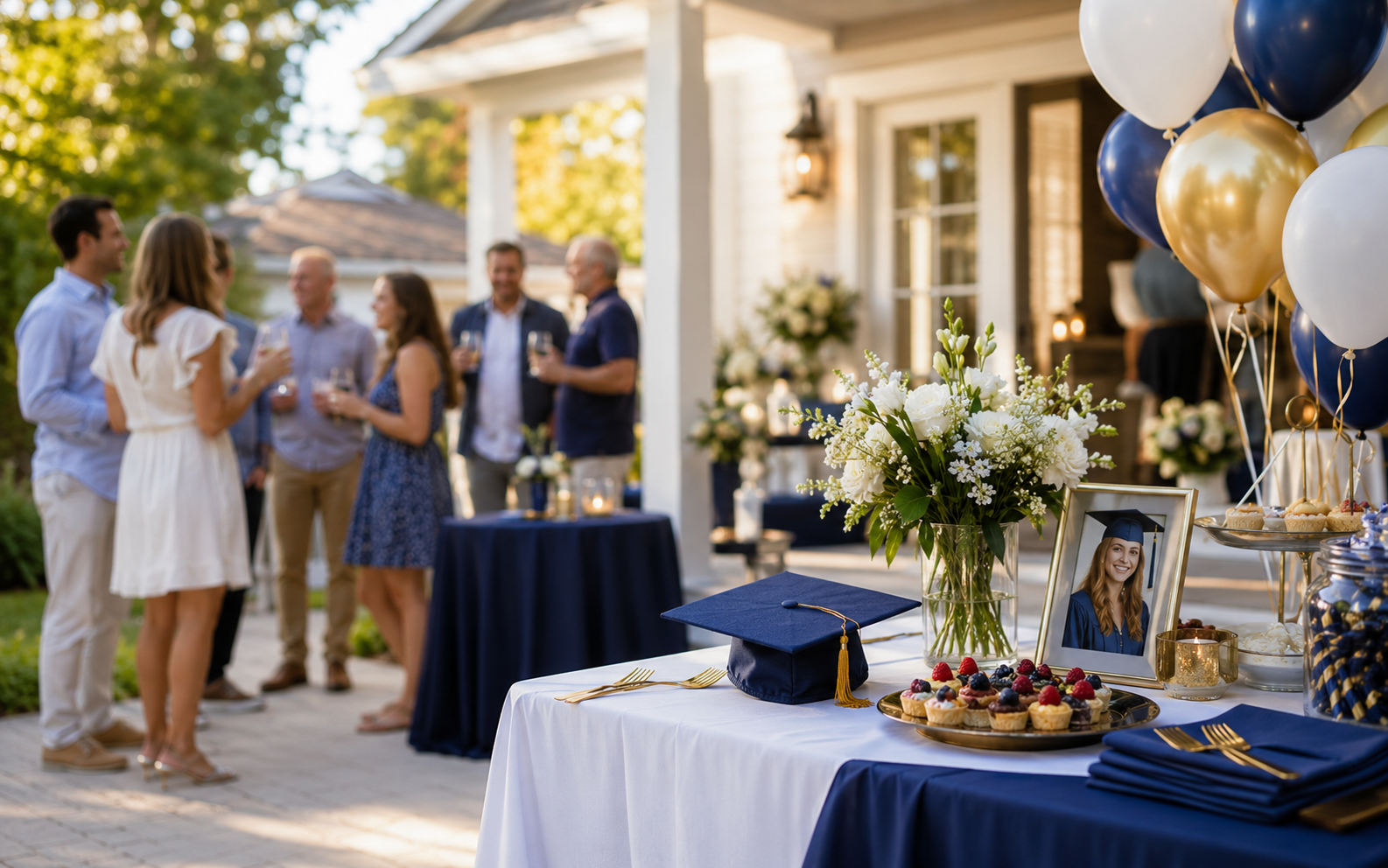
- A styled food and dessert table (the most-photographed spot).
- A memory table with childhood photos in the main gathering room.
- A QR photo sign on every table guests pass.
More layouts and color schemes: graduation party decorations.
Why photo booths struggle at open houses
A rented photo booth is booked for a 2–4 hour block, which sounds perfect — but:
- Guests are spread across the whole window, so the booth sits idle, then jams at peak hour.
- The real moments happen in the kitchen and driveway, not the booth corner.
- A booth needs a line; an open house has a trickle.
A QR guest gallery stays on the table from the first guest at 1pm to the last at 5pm — everyone uploads to the same place, no matter when they arrive. That's exactly why Grad Moments fits the open-house format: it's a photo booth alternative that never has to be manned, plus a digital guest book for audio and video messages, all for $49 once.
Setup and flow tips
- Parking sign at the curb — open houses mean street parking; help guests find you.
- A welcome table just inside so the front door doesn't bottleneck.
- Position the grad near the food, not the door — otherwise they block the entrance for four hours.
- A memory table in the main room with childhood photos and a QR sign for new ones.
- Thank guests as they leave — a favor bag is optional (favor ideas).
Open house etiquette
For hosts: you don't owe anyone a full meal — grazing food is expected. Clear hours on the invitation prevent the awkward "how long should I stay?" question.
For guests: plan to stay 20–45 minutes (longer if you're close family). Bring a card; whether to bring a gift depends on local custom.
Thank-yous: send within a month, and include the photo gallery link once it's ready — it doubles as a keepsake and a favor.
Open house checklist
- [ ] Invitations with a clear time window
- [ ] Finger food plus serving platters
- [ ] Tables for food, dessert, and gifts
- [ ] Guest book (paper or digital)
- [ ] QR codes printed and visible on every table
- [ ] Trash and recycling plan
- [ ] Weather backup if any part is outdoors
Download the free open house timeline to build your day-of schedule.
Open house invitation wording
Clarity is everything with a come-and-go format. Spell out the window and that it's not a seated meal:
- "You're invited to [Name]'s graduation open house! Drop by anytime between 1:00 and 5:00 pm, Saturday, June 14, at [address]. Light bites and dessert served — come and go as your day allows."
- "Please join us to celebrate [Name], Class of 2026. Open house 2–6 pm, Sunday, June 15. No need to stay the whole time — stop in, grab a bite, and say congrats!"
Always include the date, the time window, the address, and an RSVP method (helpful even for open houses, so you can gauge food). Add the QR gallery link if you want guests uploading from the start.
Handling multiple open houses on the same day
In graduation season, guests often hop between two or three parties in one afternoon. Plan for it:
- Expect shorter visits — many guests stay 20–30 minutes, so keep grazing food constantly available rather than timed.
- Coordinate with other families in your grad's friend group so your windows don't fully overlap — staggering by an hour lets shared guests attend both.
- Make the first five minutes easy — a clear path to food, the grad visible, and a QR sign so even a quick-stop guest leaves a photo.
Food quantities for a rolling crowd
The most common open-house question is "how much do I make?" Rough guide for a 100-person invite list (with come-and-go timing):
| Item | Amount |
|---|---|
| Sliders / sandwiches | 150–180 pieces |
| Veggie + fruit trays | 3–4 large each |
| Cheese/charcuterie | 2 large boards |
| Slow-cooker meatballs/bites | 150–200 pieces |
| Cupcakes / cookie bars | 120 pieces |
| Drinks | 200+ servings (water, lemonade, tea) |
Cater for roughly 60% of your total list eating at once, since they arrive across the window — not 100%. Leftovers freeze or send home with guests.
Help the grad pace themselves
The guest of honor stands near the door greeting people for hours and burns out fast. Coach them to take breaks, eat something, and step away for photos. Position them near the food rather than the door so they're mingling, not gatekeeping — and make sure someone brings them a plate and a drink mid-party.
Handling gifts and cards
With guests arriving all afternoon, cards and gifts pile up. Set out a decorated box or basket for cards near the entrance, keep a small notebook (or ask a helper) to jot who gave what for thank-you notes, and move gifts somewhere secure periodically so the table stays tidy and nothing walks off.
Cleanup for a come-and-go party
Because there's no single end time, cleanup is gradual:
- Restock and tidy in waves as the crowd thins, rather than all at once.
- Keep labeled trash and recycling bins visible so guests self-sort.
- Have send-home containers ready — guests love taking leftovers, and it's less for you to store.
- Break down the QR signs last; late uploads keep filling your gallery for hours after the final guest leaves.
Why the open house is so popular
The come-and-go open house has become the default for high school graduations in much of the country for reasons that go well beyond tradition. Practically, it solves the single hardest problem of a graduation party: the guest list is enormous and wildly varied. You're not just inviting the grad's friends; you're inviting your friends, both sides of the extended family, the neighbors who've watched this kid grow up, and often the families of the grad's friends too. Trying to seat and feed a hundred-plus people at one time is a logistical and financial nightmare for most households. The open house sidesteps it entirely by spreading arrivals across a window, so a modest home comfortably hosts a crowd that would never fit at once, and you feed grazing food to a rolling stream of people rather than serving a hundred plated meals simultaneously.
There's a social advantage, too. Graduation season is packed, and guests frequently have several parties to hit on the same weekend. A rigid start time forces them to choose; a two-to-four-hour window lets them stop by yours and still make the others, which means more people actually come. The relaxed, drop-in nature also suits the mixed-generation crowd — grandparents can arrive early and leave before it gets loud, the grad's friends can roll in later, and nobody feels trapped at an event that runs longer than they'd like. For the host, the format is forgiving: there's no single moment where everything has to be perfect and on schedule, just a steady, manageable flow you can ride for a few hours.
The photo problem the open house creates
For all its advantages, the open house has one genuine weakness, and it's worth naming clearly because it catches families off guard every year: there is never a moment when everyone is present at the same time. At a traditional sit-down party you get a natural window for the big group photo and posed family shots, because the whole crowd is there together. At an open house, the grad's college roommate who came at one o'clock has left long before the great-aunt arrives at four. This makes the classic "everyone in one picture" shot nearly impossible, and it means that any photo strategy built around a single moment — a hired photographer for an hour, a rented booth for a two-hour block — will miss enormous chunks of the day simply because different people are there at different times.
The strategy that actually fits the format is continuous, passive collection, which is exactly what a QR guest gallery provides. Because the QR codes sit on the tables from the first guest to the last, everyone who comes uploads their photos regardless of when they arrive, and the gallery quietly assembles the full picture of the afternoon out of dozens of overlapping visits. The one o'clock roommate and the four o'clock great-aunt both contribute, even though they never crossed paths. You end up with a complete record of a party that was, by design, never all in one place — which is something no booth or single photographer could ever deliver. It's the reason the open house and the QR gallery are such a natural pairing, and why building the gallery into your plan from the start turns the format's biggest weakness into a non-issue.
Setting the right time window
The single most important decision for an open house is the time window, because it shapes how many guests come, how long they stay, and how much food you burn through. The reliable sweet spot is a two-to-four-hour block in the early-to-mid afternoon — something like one to five, or two to six — which is long enough for guests juggling multiple parties to fit yours in, yet short enough that you're not on your feet all day. A window that's too short forces everyone to arrive at once, which defeats the entire come-and-go purpose and overwhelms your space; a window that's too long exhausts you and stretches the food across more hours than it can survive. Four hours is about the practical maximum before host fatigue sets in and the party loses its energy.
Think, too, about where your window sits relative to other events. During peak graduation season, your guests likely have two or three open houses on the same day, so a mid-afternoon slot lets them chain visits comfortably. If you know several families in your grad's circle are hosting the same weekend, a quick comparison of windows means shared guests can attend everyone's rather than being forced to choose. State the hours prominently and unambiguously on the invitation — "Open house, 1:00 to 5:00 pm, drop by anytime" — because vague or missing timing is the number-one cause of an awkward party that's either dead empty or slammed all at once. Clear hours also quietly answer the guest's unspoken question of how long they're expected to stay, which makes everyone more relaxed about stopping in even briefly.
Estimating how many guests will actually show
One of the hardest parts of planning an open house is that your invite list and your actual attendance are two very different numbers, and over- or under-estimating either one leads to stress. Because the format is casual and guests aren't committing to a single seated event, no-shows and drop-ins both run higher than at a set-time party. As a rough rule, expect a meaningful fraction of your invited guests not to make it at all, and of those who do come, remember they'll be spread across your entire window rather than present simultaneously. This is why open-house hosts cater for peak-hour attendance — the busiest single stretch, usually the middle of the window — rather than for the full guest list, and why a home that seats thirty can comfortably host well over a hundred invitees across an afternoon.
Gathering even loose RSVPs helps enormously, so ask for them on the invitation even though the format is come-and-go; frame it as "let us know if you plan to stop by" rather than a formal commitment. Track the responses as they arrive and watch for patterns — a cluster of family saying they'll come early, a group of the grad's friends signaling late afternoon — because that intelligence helps you time your food replenishment and staffing. Build a buffer into your quantities regardless, since open houses attract more unannounced plus-ones and neighbors than formal parties do. When in doubt, plan for a steady, manageable flow rather than a single crush, keep the grazing food continuously stocked so late arrivals aren't greeted by empty trays, and accept that some guessing is inevitable. The beauty of the format is its forgiveness: a rolling crowd is far easier to absorb than a hundred people arriving at once, so even an imperfect estimate rarely becomes a crisis.
Keeping the food fresh across a long window
Food is uniquely challenging at an open house because it has to look and taste appealing from the very first guest to the very last, potentially four hours apart. The strategy that makes this work is to serve in replenishable batches rather than putting everything out at once. Keep a reserve in the kitchen and refresh the trays and boards periodically, so a guest arriving at the end of the window encounters a spread that looks nearly as inviting as it did at the start, not a scavenged battlefield of crumbs and wilted garnish. Choose foods that hold up well at room temperature over hours — sliders, wraps, pinwheels, cured meats and cheeses, fresh fruit and veggies, and sturdy desserts like cookie bars and cupcakes — and steer clear of anything that wilts, dries out, or becomes unsafe after sitting too long.
Food safety deserves genuine attention over a long window, especially outdoors in summer heat. Keep hot foods hot in slow cookers or chafing dishes and cold foods cold on ice or in shallow trays you swap out, and don't let perishable items linger in the danger zone for hours. Serving in smaller, frequently refreshed portions rather than one giant spread naturally limits how long any single batch sits out. Set up the food as a self-serve station with clear labels — including notes for common allergens or dietary needs — so guests help themselves without you hovering, and position it to create smooth traffic flow rather than a bottleneck. Have send-home containers ready for the end, because guests love taking leftovers and it spares you a refrigerator packed with food. Handled this way, your spread stays gracious and abundant from the first knock on the door to the last goodbye, and while everyone eats and mingles, the QR codes on each table quietly gather the photos that turn a long, rolling afternoon into a single shared album.
Related: Open house graduation party (variant guide) · Graduation party ideas · How to plan a graduation party · Homepage
Frequently Asked Questions
Collecting guest photos?
Grad Moments gives your guests a QR code to upload photos and videos — no app, no login.
See How It Works